
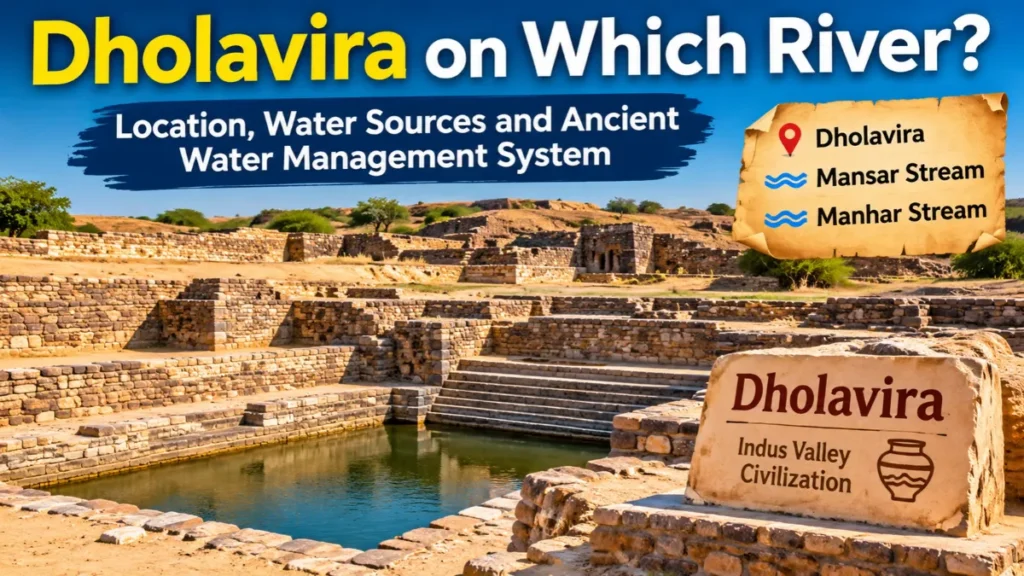
Dholavira on which river is a common question among people interested in ancient Indian history and the Indus Valley Civilization. Dholavira is one of the most important archaeological sites in India, located in the Kutch district of Gujarat. Unlike many ancient cities that developed along major rivers, Dholavira was built near seasonal water channels and relied on an advanced water management system to collect and store rainwater.
Dholavira was an important urban settlement of the Harappan Civilization, also known as the Indus Valley Civilization. Its location, architecture and water conservation techniques make it a remarkable example of ancient town planning.
Dholavira on Which River?
Dholavira is not situated directly on the bank of any major river. It is located on Khadir Bet, an island-like area in the Great Rann of Kutch, Gujarat. The ancient city was associated with seasonal streams, particularly the Mansar and Manhar channels, which helped provide water to the settlement.
These seasonal water channels played an important role in supporting life in the ancient city. Since the region receives limited rainfall and has a dry climate, the people of Dholavira developed an impressive system to collect, store and manage water.
Therefore, when asking Dholavira on which river, it is important to understand that the city was supported by seasonal streams rather than a permanent river.
Where Is Dholavira Located?
Dholavira is situated on Khadir Bet in the Kutch district of Gujarat, India. It lies within the Great Rann of Kutch, a large seasonal salt marsh known for its unique landscape and natural beauty.
The archaeological site is located approximately 220 kilometres from Bhuj, the main city of Kutch. Its isolated geographical position made it a distinctive settlement during the Harappan period.
Dholavira was strategically located between important ancient trade routes. Its people maintained connections with other Harappan settlements and possibly with regions beyond the Indian subcontinent.
Importance of Mansar and Manhar Streams
The Mansar and Manhar streams were important to the development of Dholavira. These seasonal water channels supplied water during the rainy season, helping the ancient population manage its daily needs.
The people of Dholavira understood the importance of water conservation. Instead of depending entirely on natural water sources, they constructed large reservoirs, channels and storage facilities.
These structures helped collect rainwater and preserve it for use during dry periods. The remains of these water management systems show how advanced the engineering knowledge of the Harappan people was.
Dholavira’s Advanced Water Management System
One of the most impressive features of Dholavira is its sophisticated water conservation system. Archaeologists have discovered several large reservoirs around the ancient city.
These reservoirs were carefully designed to collect and store rainwater. Stone-built channels directed water towards storage areas, while the reservoirs helped maintain supplies throughout the year.
The system demonstrates that the people of Dholavira understood the local environment and developed practical solutions to overcome water shortages.
Even today, Dholavira is considered an important example of sustainable water management and ancient engineering.
Also read: Dholavira: India’s Ancient Marvel That Earned Global Recognition from UNESCO
Historical Importance of Dholavira
Dholavira was one of the largest and most significant cities of the Indus Valley Civilization. Archaeological evidence suggests that the settlement flourished approximately between 3000 BCE and 1500 BCE, although its development took place over several cultural phases.
The city had impressive urban planning, including a fortified area, residential sections, open spaces and sophisticated drainage arrangements.
Dholavira is also famous for its large ancient signboard, which is considered one of the most remarkable discoveries associated with the Harappan script.
In July 2021, Dholavira was added to the UNESCO World Heritage List, recognising its outstanding historical and cultural importance.
Conclusion
Dholavira on which river is an interesting question because this ancient Harappan city was not built beside a major permanent river. Instead, it depended on seasonal streams, particularly the Mansar and Manhar channels, along with an advanced rainwater harvesting system.
Located on Khadir Bet in Gujarat’s Kutch district, Dholavira demonstrates how an ancient civilization successfully adapted to a dry environment. Its water reservoirs, urban planning and historical remains continue to attract archaeologists, historians and tourists from around the world.
Also read: Dholavira vs Lothal: A Unique Story and Detailed Comparison of Two Great Indus Valley Cities