
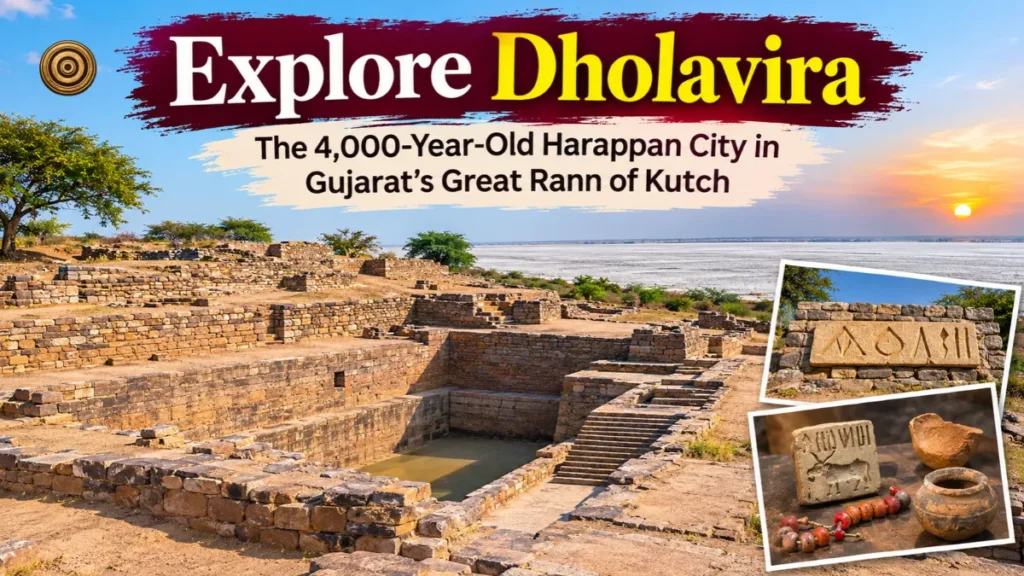
Explore Dholavira and discover one of the most remarkable ancient cities of the Indus Valley Civilisation. Located in the Great Rann of Kutch in Gujarat, India, Dholavira is a fascinating archaeological destination where ancient architecture, impressive water management systems and the natural beauty of the white salt desert come together.
Dating back more than 4,000 years, this historic settlement offers a rare opportunity to understand how people lived, worked and survived in a challenging desert environment thousands of years ago. What makes Dholavira particularly special is the way its inhabitants managed limited water resources. They developed an advanced system of reservoirs, channels and drainage structures to collect and store rainwater for the dry months.
Recognised as a UNESCO World Heritage Site in 2021, Dholavira is among the best-preserved archaeological sites of the Harappan Civilisation in South Asia. Today, its ancient streets, massive gateways, stone structures and reservoirs attract history enthusiasts, researchers and travellers interested in India’s rich heritage.
Explore Dholavira: Discover the History of an Ancient Harappan City
Dholavira is situated on Khadir Bet, an island-like area surrounded by the seasonal landscape of the Great Rann of Kutch. Archaeological evidence suggests that the settlement was occupied between approximately 3000 BCE and 1500 BCE.
Unlike many other ancient settlements, Dholavira was developed in a region where water was not easily available throughout the year. Its residents understood the importance of planning and developed an organised urban system that helped them manage the difficult environmental conditions.
The city was positioned between two seasonal water streams, known as the Manhar and Mansar. These streams played an important role in the settlement’s water supply. The inhabitants constructed channels and large reservoirs to collect rainwater and preserve it for future use.
The archaeological remains show that Dholavira was not an ordinary village. It was a well-organised urban centre with residential areas, administrative spaces, fortifications, workshops and public structures.
An Impressive Water Management System That Still Amazes Visitors
One of the biggest reasons to Explore Dholavira is its remarkable water conservation system. Even today, visitors can see the remains of large stone-built reservoirs that demonstrate the engineering knowledge of the Harappan people.
Living in a dry region meant that collecting and storing water was essential for survival. Instead of depending entirely on seasonal rainfall, the people of Dholavira developed a network of water channels, drains and storage tanks.
These structures helped direct rainwater towards reservoirs, where it could be stored and used during periods of low rainfall.
The reservoirs were carefully designed and constructed using stone. Their size and arrangement indicate that water management was an important part of the city’s overall planning.
For modern visitors, these ancient structures offer an interesting lesson in sustainable living. Long before modern water conservation technology existed, the people of Dholavira had already developed practical ways to make the best use of available natural resources.
Understanding the Unique Layout of Dholavira
Dholavira is particularly interesting because of its organised city planning. Archaeological excavations have revealed a settlement divided into different sections, each serving a specific purpose.
The major areas included the Castle, Bailey, Middle Town and Lower Town, along with an important ceremonial ground.
The fortified Castle was one of the most significant parts of the settlement. Its strong defensive structures suggest that it served an important administrative or residential purpose.
The Bailey was another enclosed section connected with the upper part of the city. The Middle Town and Lower Town contained residential areas and other facilities for the population.
The differences in the size and arrangement of houses indicate that the city had a structured social organisation. Its gateways, walls and internal divisions also demonstrate the planning skills of its builders.
Walking through these remains gives visitors an opportunity to understand how an ancient urban community organised its everyday activities.
Ancient Crafts, Jewellery and Trade Connections
Dholavira was not only known for its architecture and water conservation. It was also an important centre of craftsmanship and commercial activities.
Excavations have uncovered evidence of bead-making workshops and several objects made from different materials. These discoveries provide valuable information about the skills and lifestyle of the people who lived here.
Some of the important materials discovered at the site include:
- Copper and stone objects.
- Shell ornaments and decorative items.
- Beads made from semi-precious stones.
- Terracotta objects and pottery.
- Gold and ivory artefacts.
- Tools and other everyday objects.
These discoveries suggest that Dholavira had connections with other settlements belonging to the Harappan Civilisation.
Evidence also indicates that its trading networks extended beyond the Indian subcontinent, including connections with regions such as Oman and Mesopotamia.
Such findings help historians understand that the Harappan people were involved in long-distance trade and had developed impressive skills in manufacturing and transportation.
The Mysterious Indus Script of Dholavira
Another fascinating discovery at Dholavira is a large inscription made using symbols of the Indus script.
Archaeologists discovered gypsum pieces containing several symbols believed to have been displayed near an important gateway of the ancient city. The discovery is particularly significant because it provides evidence of how written symbols may have been used in public spaces during the Harappan period.
However, the Indus script has not yet been successfully deciphered. Researchers continue to study its symbols in the hope of understanding the language, communication system and cultural practices of this ancient civilisation.
The archaeological site also contains a cemetery with different types of memorial structures and cenotaphs. These discoveries provide additional clues about the burial customs and possible beliefs of the people who lived in Dholavira.
Visit the Dholavira Archaeological Museum
After exploring the ancient city, visitors should also make time to visit the nearby archaeological museum.
The museum helps explain the history of Dholavira through objects recovered during archaeological excavations. It offers a closer look at the everyday lives, craftsmanship and cultural traditions of the Harappan people.
Some of the important exhibits include pottery, seals, beads, ornaments, tools and other archaeological discoveries.
For visitors who are seeing Dholavira for the first time, the museum makes the experience more meaningful. After walking through the ancient settlement, seeing the objects discovered there helps connect the remaining structures with the people who once lived in the city.
It is a worthwhile stop for anyone interested in archaeology, Indian history and the Indus Valley Civilisation.
Why Did the Ancient City of Dholavira Decline?
Although Dholavira remained an important settlement for centuries, its urban character gradually changed over time.
Archaeological evidence suggests that the city experienced different phases of occupation. Its decline was not necessarily caused by one sudden event.
Researchers have considered several possible reasons behind the transformation of the settlement, including changes in climate, declining water availability, shifts in trade networks and pressure on natural resources.
Environmental changes may have affected the seasonal streams that supported the city’s water supply. As conditions changed, maintaining the same level of urban activity may have become increasingly difficult.
The settlement continued to experience later phases of occupation, but its earlier urban structure was eventually abandoned.
Today, its surviving remains provide important evidence of how ancient communities adapted to environmental challenges and how changing natural conditions could influence the development of a civilisation.
Explore Dholavira Village and the Beautiful Great Rann of Kutch
A trip to Dholavira is not limited to archaeological monuments. The surrounding landscape also offers plenty of reasons to spend more time in this part of Kutch.
The modern village of Dholavira is located approximately one kilometre south of the excavated archaeological settlement. Visiting the village allows travellers to experience the local environment and understand the connection between the historic site and present-day life on Khadir Bet.
Another interesting attraction nearby is the Fossil Park, where visitors can learn about the region’s geological history.
The surrounding salt flats and seasonal wetlands create a distinctive landscape. During winter, migratory birds, including flamingos, may also be seen in suitable wetland areas. However, bird sightings depend on seasonal conditions.
For nature lovers and photographers, the changing colours of the Great Rann make this destination particularly attractive.
Experience the Road to Heaven Near Dholavira
One of the most memorable experiences during a Dholavira trip is travelling along the famous Road to Heaven.
This beautiful road passes through the vast white salt desert and connects Khadir Bet with the mainland. The long stretch of road surrounded by salt flats creates a unique experience, especially for people visiting Kutch for the first time.
Sunrise and sunset are particularly beautiful here. During these hours, the changing sunlight creates different shades across the white landscape.
The area also becomes attractive after sunset. With relatively low artificial lighting in the surrounding region, visitors staying overnight may get an opportunity to enjoy the night sky and observe stars.
Rather than completing the journey in a hurry, spending a night near Dholavira can make the overall experience more enjoyable.
Where to Stay Near Dholavira
Travellers planning to explore the archaeological site can find accommodation options in and around Dholavira.
One of the known accommodation options is Praveg Resort, located approximately 1.5 kilometres from the archaeological site. Staying nearby makes it easier to reach the ruins early in the morning and enjoy the surrounding landscape during the evening.
Winter is a popular time to visit Kutch, so booking accommodation in advance is a sensible decision.
Visitors travelling from Bhuj should also plan their fuel and essential supplies before starting the journey. Facilities and mobile network coverage can be limited in some areas around Khadir Bet.
Enjoy Traditional Kutchi Food During Your Visit
A visit to Dholavira is also a good opportunity to experience the traditional food culture of Kutch.
Kutchi cuisine is known for its simple ingredients, distinctive flavours and traditional cooking methods. Many local dishes are prepared using ingredients that are commonly available in the region.
Some dishes worth trying include:
- Bajra Rotla: A traditional flatbread prepared using pearl millet flour.
- Kutchi Kadhi: A popular yoghurt-based preparation with a distinctive flavour.
- Khichdi: A simple and comforting dish made with rice and lentils.
- Odho: A traditional preparation similar to baingan bharta, made using roasted vegetables.
- Kutchi Dabeli: A famous regional snack featuring a spiced potato filling served inside a bun.
Travellers can also enjoy curd, buttermilk and seasonal vegetable preparations as part of a traditional Kutchi meal.
For a wider food experience, visitors can explore local restaurants in larger towns such as Bhuj and Mandvi.
Rann Utsav: Add Another Experience to Your Kutch Trip
If you are planning to Explore Dholavira during the winter season, you can also consider adding Rann Utsav to your travel itinerary.
Organised at Dhordo in the Great Rann of Kutch, Rann Utsav celebrates the traditional culture, handicrafts, music and dance of Gujarat.
The festival offers visitors an opportunity to experience local traditions, explore handmade products and enjoy cultural performances against the backdrop of the White Rann.
The 2026–27 edition is scheduled to take place from November 1, 2026, to March 7, 2027.
Although Dhordo and Dholavira are different destinations, travellers planning a longer Kutch holiday can include both in their itinerary.
Explore Other Important Harappan Civilisation Sites in India
Dholavira is one of several important archaeological destinations connected with the Indus Valley Civilisation. Travellers interested in ancient Indian history can also explore other Harappan sites across the country.
Lothal, Gujarat
Lothal is another important archaeological destination in Gujarat. It is particularly known for its large basin, traditionally identified by archaeologists as an ancient dockyard.
Excavations have also uncovered warehouses, bead-making workshops, seals and other objects that provide evidence of commercial activities.
The discoveries at Lothal suggest that its people maintained trade connections with regions beyond the Indian subcontinent, including the Persian Gulf and Mesopotamia.
Rakhigarhi, Haryana
Rakhigarhi is among the largest known Harappan archaeological sites in India.
Its extensive settlement mounds, residential remains, streets, drainage systems and craft-related discoveries offer valuable information about the development of ancient urban communities.
The site is particularly important for understanding the scale and organisation of Harappan settlements.
Kalibangan, Rajasthan
Kalibangan is another significant archaeological site associated with the Indus Valley Civilisation.
Located near the dried bed of the Ghaggar River, it contains evidence of both pre-Harappan and Mature Harappan settlements.
One of its most interesting discoveries is an ancient ploughed field showing intersecting furrows. This provides important evidence about agricultural practices during the early phases of settled life.
Excavations have also revealed a fortified citadel, residential areas and fire altars.
Each of these archaeological destinations tells a different story about the Harappan world. However, Dholavira stands out because of its impressive water conservation system and the way its inhabitants adapted their city to the challenges of an arid environment.
Also read: Dholavira: Discover the Ancient Wonder of the Indus Valley Civilization
Best Time to Explore Dholavira
The best time to Explore Dholavira is generally between October and March.
During these months, temperatures are comparatively comfortable, making it easier to walk around the archaeological site and explore the surrounding salt desert.
Winter is also a good period for photography, sightseeing and experiencing the wider Kutch region.
Summer temperatures can become extremely high, particularly during the afternoon. Travellers visiting during warmer months should take additional precautions and avoid spending too much time outdoors during peak sunlight hours.
How to Reach Dholavira, Gujarat
Dholavira is located in the Kutch district of Gujarat. Although the archaeological site is situated away from major cities, it can be reached by road from Bhuj.
By Air
Bhuj Airport is the nearest major airport commonly used by travellers visiting Dholavira. Visitors arriving from other Indian cities can plan their journey through Bhuj and continue towards Khadir Bet by road.
By Train
Bhuj is also the main railway hub for travellers planning a visit to Dholavira. From Bhuj Railway Station, visitors can hire a private taxi or arrange a vehicle for the onward journey.
By Road
Road travel is the most convenient way to reach Dholavira.
The journey from Bhuj generally takes around three to four hours, depending on the route, road conditions and traffic.
Travellers can use the newer approach through Khavda and the Road to Heaven. Another route is available through Rapar and Bhachau.
It is advisable to check the latest road conditions before starting the journey.
Important Travel Information for Dholavira
| Travel Details | Information |
|---|---|
| Destination | Dholavira |
| Location | Khadir Bet, Kutch, Gujarat |
| Historical Period | Approximately 3000–1500 BCE |
| Civilisation | Indus Valley Civilisation |
| UNESCO Recognition | 2021 |
| Nearest Major City | Bhuj |
| Nearest Airport | Bhuj Airport |
| Best Time to Visit | October to March |
| Recommended Visit Duration | At least half a day |
| Nearby Attractions | Road to Heaven, Fossil Park, Great Rann of Kutch |
| Popular Experience | Ancient reservoirs and Harappan ruins |
Also read: Dholavira History: Discover the Ancient City of the Indus Valley Civilization
Useful Tips Before Visiting Dholavira
A little preparation can make your visit to this historic destination much more comfortable.
- Wear comfortable walking shoes because exploring the archaeological site involves walking across uneven ground.
- Carry sufficient drinking water, especially if you are visiting during warmer weather.
- Wear a hat, sunglasses and sunscreen to protect yourself from the strong sunlight.
- Keep enough time for both the archaeological ruins and the museum.
- If you are planning to stay overnight, book your accommodation in advance during the winter season.
- Fill your vehicle’s fuel tank before leaving Bhuj, as petrol stations and other facilities may be limited along the route.
- Download offline maps before travelling because mobile network coverage may not be reliable in every area.
- Consider hiring a knowledgeable local guide to understand the history and importance of the ancient structures.
Conclusion: Why Explore Dholavira Should Be on Your Gujarat Travel List
Explore Dholavira to experience a remarkable chapter of India’s ancient history. This 4,000-year-old Harappan settlement is much more than a collection of archaeological remains. It represents the intelligence, planning and practical knowledge of a civilisation that learned to live in a challenging desert environment.
From its impressive water reservoirs and carefully planned streets to its mysterious Indus script and ancient trade connections, every part of Dholavira offers something interesting to discover.
The surrounding Great Rann of Kutch adds another dimension to the journey, with its beautiful salt landscapes, traditional Kutchi culture and peaceful natural surroundings.
Whether you are a history enthusiast, a photographer, a student or simply someone who enjoys exploring unusual destinations, Dholavira deserves a place on your Gujarat travel itinerary.
Also read: Dholavira Archeological Museum Guide: Ticket Price, How to Reach & Hidden Harappan Secrets Revealed