
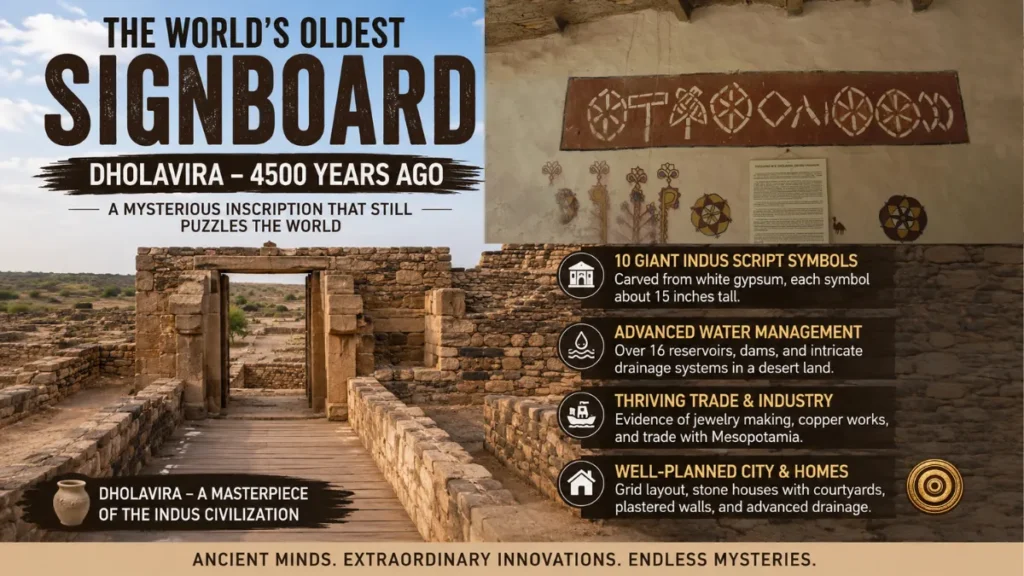
Dholavira Signboard: Hidden in the arid landscape of Gujarat, India, Dholavira stands as one of the most remarkable cities of the ancient Indus Valley Civilization. Established around 2500 BCE, this extraordinary settlement was far ahead of its time, featuring advanced urban planning, sophisticated water conservation systems, thriving industries, and long-distance trade networks. Among its most fascinating discoveries is a giant inscription often described as the world’s oldest known signboard, a remarkable artifact that continues to puzzle archaeologists today.
The Mysterious Dholavira Signboard
One of Dholavira’s most celebrated discoveries is a massive inscription placed near the northern entrance of the city’s fortified citadel. Researchers believe this signboard was positioned where every visitor, merchant, and traveler entering the city could easily see it.
The inscription contains ten large symbols from the Indus script. Each symbol measures approximately 15 inches (about 37 centimeters) in height, making them significantly larger than most other examples of Indus writing found across archaeological sites.
The symbols were carefully crafted using white gypsum material and originally fixed onto a wooden board. Although the wooden frame disappeared over thousands of years, the gypsum letters survived in their original sequence. Despite decades of research, the script has not yet been deciphered, leaving the message behind this remarkable signboard one of archaeology’s greatest mysteries.
A City Designed Centuries Ahead of Its Time
Dholavira was not an ordinary ancient settlement. It was a carefully planned city with separate residential, administrative, and public zones connected through well-organized streets.
The city’s planners demonstrated exceptional engineering skills by creating wide roads, fortified walls, public spaces, and carefully divided neighborhoods. Every part of the settlement appears to have been designed with purpose, reflecting a highly organized urban society.
Extraordinary Water Management System
One of Dholavira’s greatest achievements was its innovative approach to water conservation.
Located in a dry region with limited rainfall, the city’s inhabitants developed an impressive system to collect, store, and manage precious water resources. They built more than sixteen large reservoirs, check dams, underground storage tanks, and stone-cut drainage channels that captured seasonal rainwater.
Instead of allowing monsoon water to flow away, the city redirected it into massive reservoirs that supplied water throughout the year. This engineering achievement allowed Dholavira to flourish in an environment where water scarcity was a constant challenge.
Manufacturing and Skilled Craftsmanship
Excavations show that Dholavira was also an important industrial center.
Archaeologists have uncovered workshops where skilled craftsmen produced beads, jewelry, shell ornaments, and other decorative objects. Evidence of copper working and specialized manufacturing indicates that the city’s economy relied on both craftsmanship and trade.
The discovery of standardized tools and production areas suggests that many goods were manufactured in an organized manner, reflecting a sophisticated economic system.
International Trade Connections
Dholavira was not isolated from the rest of the ancient world. Archaeological discoveries indicate that the city maintained trade links with distant civilizations, including Mesopotamia.
Gold, silver, bronze objects, semi-precious stones, and other valuable materials discovered at the site demonstrate that Dholavira participated in long-distance commercial exchange. These trade connections helped transform the city into one of the major economic centers of the Indus Valley Civilization.
The Evolution of Homes in Dholavira
The houses of Dholavira reveal how the city’s architecture developed over nearly 1,200 years.
Unlike many other Indus cities that primarily used baked clay bricks, Dholavira’s builders made extensive use of locally available sandstone along with sun-dried mud bricks. This adaptation reflected the unique geographical conditions of the region while providing durable and practical housing.
Mature Harappan Residential Architecture
During the height of the civilization, approximately between 2500 BCE and 2000 BCE, residential buildings became increasingly sophisticated.
Most houses followed a rectangular layout and were built along well-planned streets arranged in a grid pattern. Many homes contained two to five rooms organized around a private central courtyard, providing both ventilation and family living space.
The use of carefully dressed sandstone blocks gave many buildings a solid and attractive appearance, highlighting the advanced construction techniques of the city’s builders.
Also read: Dholavira Archeological Museum Guide: Ticket Price, How to Reach & Hidden Harappan Secrets Revealed
Beautiful Interior Finishes
Archaeological studies suggest that many houses featured walls and floors coated with smooth layers of white and pink clay plaster.
These finishes not only improved the appearance of homes but also helped protect interior surfaces from wear and weather. Such attention to detail reflects the importance residents placed on cleanliness, comfort, and aesthetics.
Advanced Drainage and Sanitation
One of Dholavira’s most impressive achievements was its highly developed sanitation system.
Wastewater from homes was directed through carefully designed stone drains that connected to larger underground drainage channels. These channels included inspection openings and water traps that helped reduce blockages and kept the system functioning efficiently.
For a city built more than four thousand years ago, this level of urban sanitation demonstrates an exceptional understanding of civil engineering and public health.
Also read: Dholavira vs Lothal: A Unique Story and Detailed Comparison of Two Great Indus Valley Cities
A Lasting Legacy
Today, Dholavira remains one of the finest examples of ancient urban planning anywhere in the world. Its mysterious signboard, advanced water conservation techniques, organized neighborhoods, impressive craftsmanship, and extensive trade networks reveal the remarkable achievements of the Indus Valley Civilization.
Although the meaning of the famous ten-symbol inscription is still unknown, the city continues to provide valuable insights into one of humanity’s earliest and most sophisticated civilizations. Every discovery at Dholavira reminds us that remarkable innovation and engineering existed thousands of years before many of the world’s later civilizations emerged.