
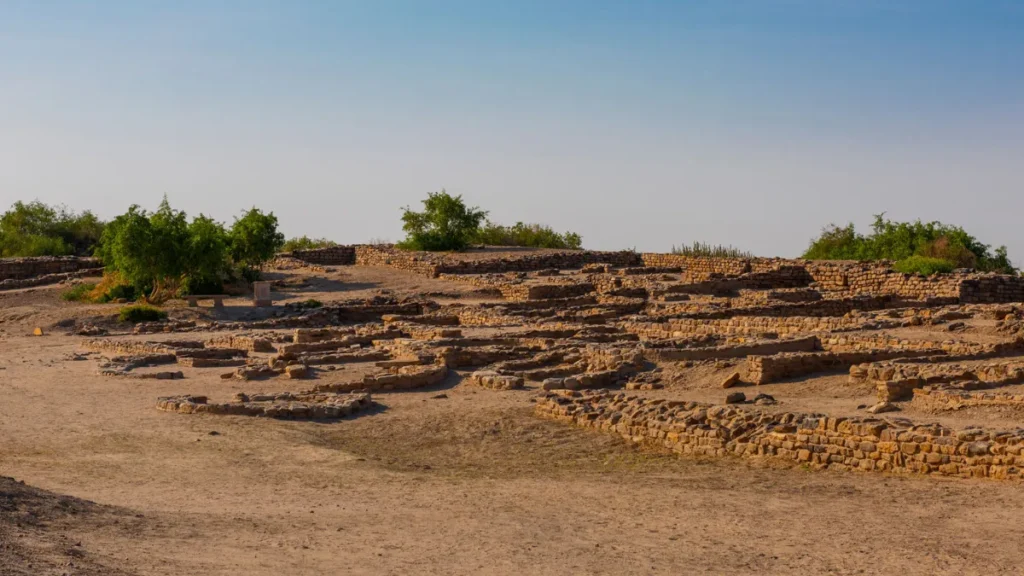
Introduction: A Historic Milestone for Gujarat
In 2021, India celebrated a major cultural achievement when Dholavira was officially recognized as a UNESCO World Heritage Site. This prestigious recognition placed Gujarat firmly on the global heritage map and marked a proud moment for India’s archaeological and cultural legacy.
With Dholavira’s inclusion, Gujarat became one of the few regions in India to host four UNESCO World Heritage Sites, showcasing its rich historical, architectural, and cultural diversity. But beyond recognition, Dholavira represents something far more profound-a window into one of the world’s oldest and most advanced urban civilizations, the Indus Valley Civilization.
This ancient city is not just a collection of ruins; it is a story of human innovation, resilience, and transformation that dates back over 4,500 years. It challenges modern assumptions about progress and reminds us that ancient societies were far more sophisticated than we often imagine.
The Location: Where Civilization Meets the Desert
Dholavira is located in the remote and striking landscape of the Great Rann of Kutch, on Khadir Island in the Kutch district of Gujarat. This region is known for its dramatic seasonal transformation-vast stretches of dry, cracked earth during summer turn into shallow wetlands during the monsoon.
The site lies on semi-arid terrain, surrounded by salt desert plains that stretch endlessly toward the horizon. Despite its harsh conditions, the area supports diverse wildlife, including the graceful Chinkara, the majestic Nilgai, and flocks of flamingos that add a splash of color to the white desert.
Two seasonal streams, known locally as “nallahs,”-Mansar to the north and Manhar to the south-played a crucial role in sustaining the ancient settlement. These water sources were ingeniously harnessed by the inhabitants, forming the backbone of Dholavira’s remarkable water management system.
The journey to Dholavira itself is unforgettable. As travelers pass through the vast expanse of the Rann, they encounter an almost surreal landscape that feels untouched by time-an ideal setting for a city that once thrived in one of the most challenging environments on Earth.
A City Lost and Found: Discovery and Excavation
Dholavira was first discovered in 1967 by the Archaeological Survey of India (ASI). However, systematic excavations began only in 1990, revealing one of the most remarkable urban settlements of the Harappan era.
What emerged from the sands was nothing short of extraordinary.
Archaeologists uncovered a wide range of artifacts that offered deep insights into the daily lives, trade practices, and craftsmanship of the people who once lived here. These included:
- Intricately designed terracotta pottery
- Beads made of semi-precious stones
- Gold and copper ornaments
- Seals with inscriptions
- Fish hooks and tools
- Animal figurines
- Burial urns
One of the most fascinating discoveries was a set of ten large stone inscriptions written in the still-undeciphered Indus script. These inscriptions are believed to be among the earliest examples of signage in human history-possibly the world’s first “signboards.”
The presence of imported artifacts also suggests that Dholavira was part of an extensive trade network, connecting it to distant civilizations such as Mesopotamia. This indicates that the city was not isolated but actively engaged in international commerce thousands of years ago.
Urban Planning Ahead of Its Time
One of the most impressive aspects of Dholavira is its advanced urban planning. The city was meticulously designed, reflecting a level of organization and engineering expertise that rivals modern standards.
The settlement was divided into three main sections:
- The Citadel (central fortified area)
- The Middle Town
- The Lower Town
Each section was independently fortified, indicating a well-structured administrative and social system.
The buildings were constructed using a combination of sun-dried bricks and finely dressed stone masonry, giving them both durability and aesthetic appeal. Streets were laid out in a systematic grid pattern, allowing for efficient movement and organization.
Even more remarkable was the city’s underground drainage system, designed for sanitation and water management. This demonstrates that the inhabitants had a clear understanding of hygiene and public health-concepts that are still critical in modern urban planning.
Another unique feature of Dholavira is its large stadium-like structure, complete with seating arrangements. While its exact purpose remains debated, it may have been used for public gatherings, ceremonies, or sporting events.
Revolutionary Water Conservation System
Perhaps the most groundbreaking feature of Dholavira is its sophisticated water conservation system-one of the earliest known in the world.
Living in a region with minimal rainfall, the inhabitants developed an ingenious method to collect, store, and manage water. The system included:
- Massive reservoirs carved into the ground
- Channels to direct rainwater into storage tanks
- Dams built across seasonal streams
- Underground storage systems
Satellite imagery has confirmed the presence of these reservoirs, highlighting the scale and precision of the engineering involved.
Without this advanced water management system, it would have been impossible for such a large settlement to survive in the harsh desert environment. It stands as a testament to the ingenuity and adaptability of the Harappan people.
The Rise and Fall of a Great Civilization
Dholavira offers a rare opportunity to study the complete lifecycle of an ancient civilization. Unlike many other Harappan sites, it shows evidence of all stages-from early development to peak prosperity and eventual decline.
The city flourished between approximately 2900 BCE and 1500 BCE. During its peak, it was a thriving urban center with advanced infrastructure, trade networks, and cultural richness.
However, archaeological evidence suggests that the civilization began to decline during its fifth stage. This was followed by a temporary abandonment of the site.
When people eventually returned, their way of life had changed dramatically.
The later settlers adopted simpler lifestyles, abandoning the complex urban systems of their predecessors. Their houses were circular structures, known as “bhungas,” which were very different from the earlier rectangular buildings.
Artifacts from this period also show influences from other regions, including Sindh and parts of Rajasthan and Gujarat, indicating cultural interactions and migrations.
What makes this transition particularly intriguing is that it appears to have been a conscious shift rather than a sudden collapse. It raises profound questions about how civilizations respond to challenges-whether environmental, economic, or social.
Dholavira, in this sense, is not just about the past; it is a reflection of human adaptability and the choices societies make in times of change.
Also Read: Dholavira: Discover the Ancient Wonder of the Indus Valley Civilization
How to Reach Dholavira
By Road
Dholavira is well-connected by road, though the journey requires careful planning due to its remote location.
- Distance from Ahmedabad to Bhuj: approximately 335 km (around 7 hours)
- Distance from Bhuj to Dholavira: approximately 250 km
Travelers typically reach Dholavira via Bhachau and Rapar. A daily bus service operates from Bhuj, departing in the afternoon and arriving in the evening. The return journey begins early in the morning.
Private vehicles or rented cars are also a convenient option, allowing travelers to explore the scenic route at their own pace.
By Train
The nearest railway station to Dholavira is Samakhiali, located about 137 km away. Other nearby stations include:
- Bhachau (152 km)
- Gandhidham (187 km)
- Anjar (191 km)
From these stations, travelers can hire taxis or use local transport to reach the site.
By Air
The closest airports are:
- Kandla Airport (191 km)
- Bhuj Airport (215 km)
Both airports are connected to major Indian cities, making it relatively easy to plan a trip to Dholavira.
Also Read: Dholavira History: Discover the Ancient City of the Indus Valley Civilization
Conclusion: Why Dholavira Matters Today
Dholavira is more than just an archaeological site-it is a symbol of human ingenuity, resilience, and evolution. Its recognition as a UNESCO World Heritage Site has brought global attention to a civilization that was far ahead of its time.
From its advanced urban planning and water conservation systems to its mysterious script and cultural transitions, Dholavira continues to inspire researchers, historians, and travelers alike.
In a world that constantly looks forward, Dholavira reminds us of the importance of looking back-to learn, to understand, and to reflect on what truly defines progress.
As we face modern challenges such as climate change and resource management, the lessons from Dholavira are more relevant than ever. It stands as a timeless reminder that innovation, sustainability, and adaptability are the true pillars of civilization.